Hi to all.
I'm wanting to fix up an old MTB and want to use three colors (black for the front, yellow for the mid and red for the rear). I didn't want the colors to just abruptly meet but instead blend into the next. I'm unsure what this technique is called and the net provided no clues.
I guessed that it's a "fade" or "blend" technique but it's a mystery how this is done.
Can this be done via "rattle can" or is a shop needed for this effect?
Thanks.................Tom
2011softcruise
“Striker, listen, and you listen close: flying a plane is no different than riding a bicycle, just a lot harder to put baseball cards in the spokes.”
Airplane (1980) – Rex Kramer (Robert Stack)
My show car has faded black to gray in the flames that was done via a professional artist using an air brush. I think that you would have to be extremely good at it to be able to do it via a spray can. However, if you tried it, I would imaging that you would do the painting in reverse. Red painted solid where the yellow fades in and yellow solid where the black fades in. If someone has done this before and I'm off base, my apologies.
HCFR Cycling Team
Ride Safe...Ride Hard...Ride Daily
what color is the frame now? or are stripping it? if the frame is aluminum you should use a chromium primer. if steel I would prep and use a non sandable primer/sealer then paint then clearcoat. spray cans do not atomize like spray guns and may spittle here and there. and never seem to setup as hard as an automotive finish. however it could be done, just do not be to picky about the results after all it is your first attempt. on the fade it will be hard to start and stop your paint stroke evenly and you will overspray where you might not want it too.
there are other techniques that produce cool effects like a crackle. That is where the color you see through the cracks in the paint are one color of your choice painted first in enamel, then your main color painted next in lacquer. then let dry and clearcoat in polyurethane
the principle is this: enamel dries longer than lacquer so the lacquer cracks in an asymmetrical pattern revealing the color beneath, after that dries a day or two the polyurethane gives it the gloss and adds a little strength to the finish. Just another Idea to think about and you will not have to be so precise with your stroke and still have a unique and custom paint job. either way practice in scrap first, then go for it and have fun
There are two kinds of people in the world, "Those who help themselves to people, and those who help people!"
Hi.
The frame is a gloss black (but rough) and is likely steel (but I'll confirm that later). I wanted to get my wife interested in biking and told her I would build a bike in her home country colors (Germany). I wanted to try to fade the color changes rather than solid borders but doing so from a can will be a challenge. I'm unsure about doing a total stripping of the frame and had planned to just lightly sand the original paint (some original paints work well for adhering to) but it's scratched and may prevent a nice covering. Perhaps spraying at a greater distance as I near the bordering color will create the effect I want.
2011softcruise
“Striker, listen, and you listen close: flying a plane is no different than riding a bicycle, just a lot harder to put baseball cards in the spokes.”
Airplane (1980) – Rex Kramer (Robert Stack)
The fading of paint requires very light trigger finger and a narrow spray pattern. In painting with spray cans or any other prep is the most important thing. If current paint is good no need to strip it, just sand it lightly with 400 grit wet, clean with paint prep cleaner use good primer and than paint. You can buy supplies at automotive paint shops, also lots of good info. Best to use supplies from the same manufacturer for compatibility. Kraylon is good.
Oil enamel is super durable but harder to work with and clean.
Practice technique before spraying the frame.
BTW you can get custom colors mixed and loaded into a spray can..
Few tricks in using spray cans , warm it up in a tub of warm water, shake well, shake frequently as you paint , clear nuzzle once in a while, start and finish spray pattern OFF the frame. This is very important, start spray off the frame spray across and past the frame and than stop.
As far as crackling, lacquer will lift enamel paint. You can spray enamel over lacquer but NOT the other way around. Do not ask how I know. :-))
Never Give Up!!!
always remember your tack cloth!
There are two kinds of people in the world, "Those who help themselves to people, and those who help people!"
Never saw this thread, and I really do not care for the look (except with retinato/pattern type fades) even on bikes I ride. I prefer bold contrasts so banding and striping are more my speed, and are easier. All advice is good though one point was missed. It does depend on exactly how you want the "fade" to appear and how many colors.
You can make a fairly short fade that from a distance appears more as separate colors just like standard masking for doing bands, but at closer inspection is obviously faded. That technique is not used often except with colors that are closer in shade and color between between each change; looks good if going from, for example, a very dark blue to a lighter blue, or even black to white using increasingly lighter shades of gray. You need many shades to do it properly and it is time consuming).
You can save some money if doing the base color with lower cost paint since your obviously using more product (this applies regardless of how many colors, long or short fade.
Doing a long color fade with a nice look at a distance is easier. You would generally decide if one color would be dominant or not. With a dominant color you should paint the entire frame in that color and add other color over the top. You can do a partial section, but you ara still going to be extending your prime base color well beyond the next fade coat of a different color. If doing a 3 color fade, paint the middle color first. Again, easy to just paint that as your base color on the entire frame and then add the fade colors on each end.
Practice on a flat surface first, and then on some tubing (it is much more difficult!) before doing a frame.
Clear coat is a must after painting, as the speckled fade areas are easily worn off compared to the rest of the paint in solid areas.
In the end if painting my personal frames I'll have it done professionally. The cost of paint is not cheap nowadays, nor is the proper equipment; nevermind the time and waste you will experience if never having done it. For stuff I have sold it was best left original due to age, scarceness, and getting proper decals (if even availble) and loss of value. I let new owners do what they want; though most want the original patina found on frames 35 yrs older or more.
Note: best to not sand off old paint on lighweight racing frames since wall thickness of tubing is generally 0.5mm to 1mm thick on steel frames. You can compromise the tubing if thinning those tubes with abrasives; a good reason not to purchase repainted frames unless you know who and how the work was performed, and for what reasons (just bad paint, changing colors, and/or rust [which can be external and internal]).
If rust I recommend staying away from buying a frame since you have no idea how deep is was so much easier to have a compromised frame. I have often seen a frame being "repaired" to "surface" rust being removed. First a tiny pinhole appears, then it gets bigger and bigger where internal rot occurred. Even fixing that area is not a guarantee that there is not more rot that has yet to become thin enough to affect the outward appeareance (after stripping), but may have compromised the frame regardless. Frame gets "repaired" and repainted only to fail elsewhere. It's your own safety, or someone else's safety if passing it along so do what you are comfortable with.
Extra Note: you can measure thickness of tubing, but expect to pay hundreds to thousands of dollars for decent accuracy (you can go cheap with reduced accuracy; but then why bother). I used equipment in my engineering work, but not worth it if you are not in a profession where you would not be using it regularly and being paid $50-$100 an hour or per test to do the testing. E.g. yes sir, I just tested your $200 frame and it is bad. That will be $50, thank you very much.
Location: Silver City, NM, USA
Here's how it's done in Lordsburg, NM... it's a one-step program, lol.

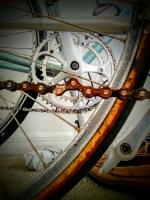
Step #1: Leave the bike in the hot desert sun for 170 years... when it looks like these pics, you'll know it's done!


Just kidding, but for those interested in old ghost towns, you can see the rest of the pics at
http://frugalvillage.com, just look for 'Shakespeare' in the thread title, lol. Rode the thumper down there last week, finally got around to posting the pics today.

In case I don't make it back before Christmas, well, "MERRY CHRISTMAS TO ALL!!!" I'll think of y'all as I pound a cold beverage later this afternoon, lol. CHEERS!

"Nothing ventured, nothing gained..."





![[-]](https://forums.bikeride.com/images/flatty/collapse.png "[-]")