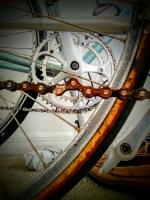
I just spent about a month riding back on a 44T oval ring, and it was grueling for me compared to how I remember it and what I'm used to now.
I recently switched back to a 52T oval ring with a 11-32 cassette and the difference is phenomenal.
I'm telling you...if you haven't given this any thought...switch to a large chainring with a ride range cassette for the efficiency gains in the lower gears.
If you don't ride oval yet, please try oval as well!
New Shimano Cues sets make this more viable than ever! But I would say their range is a little extreme even, and really want to push the higher gear numbers to capture the prime versatility.
I'm thinking you are referring to the elliptical shaped chainring? I had that on my old specialized back in the late 90s popularized by Chris Froome. I have a 52/34 on my current bike. Not sure about riding a 1x regardless of the cassette range. If your riding around the country, or world, there comes a time where you need to drop into that small ring, and conversely, hammer those watts in the 52-11!
Two Wheels
Stay Safe
Robert
"SPINMAN"
If you mean Biopace, it's only in the style of that.
Today's oval rings use a lot more ovality than the Biopace rings.
Normally, I would agree with you on the versatility, but I have gained too much experience to feel otherwise now. If you have a wide enough range cassette in the back, simply shifting up into the lower gears will carry you with even better efficiency than having a second smaller ring in the front. This gains even more momentum when you are using higher speed setup (1x10 or 1x11)—and utilizing a mega wide range like I mentioned Shimano Cues series having.
For people looking to try something new, or break away from a lot of nagging pain they get from spinning a smaller ring, they should definitely consider a large oval ring for the front with a wide range cassette in the back.
I have something to add to this now.
Yesterday I had an incident where I got a chain drop while bombing and it caused my derailleur to get ripped right off the frame when the gain got caught in the spokes. Thankfully, I was able to stop without crashing or anything. The wheel was wrecked and there's some other minor damages, which will be easily recoverable.
What happened was...the chainlength was too long, so that the derailleur got pulled forward. This caused the chaindrop. When I measured and cut the chain, everything was looking good. I didn't notice any hard pulling forward like that, or chain skipping, or other red flags that would be cause for alarm. I did believe the chain might be a link too short, but since I'm running such a large ring in the front with a 11-32 in the back, I needed that length to get into the largest cog. When I shift tested up into the largest gear, I could clear it, and the derailleur looked fully extended forward and very close to that crucified position (which I try to avoid). Using oval rings, I've had a lot of issues with cutting the chain too short, and then not being able to get up into that gear. After ruining so many chains like that, I've gotten weary of trying to "fine tune" that one extra set of links. I did a lot of ride tests and didn't have any issues, but here we are to today, with me now having to rebuild my rear wheel because of this incident.
I want to relay this information because the rear derailleur that I was using was a M360 Acera. This derailleur doesn't have a Shadow clutch. For those that don't know, the Shadow clutch is a mechanism that prevents the derailleur from being pulled forward, to prevent this very issue from happening out on the trail. On many newer derailleurs that are designed for very wide range cassette, they have this Shadow clutch. And for older setups, there's the Shimano ZEE M640.
Please note to anyone what wants to try this, if you go to do an extremely large to large setup, you will absolutely want a Shadow clutch derailleur. Do not attempt this build on older style components that don't have a Shadow clutch, because you may not be able to secure the chain tightness necessary to prevent this. You will have to limit the cassette range in the back, of which I am going to drop down to an 11-28 for this very reason as well. A bit of turning lemons into lemonade, as I would hate for this to happen to anyone else.
Wow, that must have been hairy! So, with the shadow clutch, you would have avoided that incident? I guess it's most valuable in mountain biking and trails. My road bike is 52/43 with 11-26 rear cassette.
Yes, I was thinking of the biopace. I didn't know they had an elongated oval. More for MTB, I suppose. Must feel nice coming over the top of the pedal.
I'm still not comfortable with the 1x idea, I like to know I can drop down to my 43 if I encounter a 10% + gradient or I'm not feeling strong that day and want to ride a higher RPM. I geuss a 1x 50 with 11-32 might work!
(06-20-2026, 02:24 AM)GirishH Wrote: @ReapThaWhirlwind, it's crazy what a difference a "few teeth" can make...
When I was discussing my struggles with climbing in the mountains of Ecuador with bike mechanics, almost everyone suggested upgrading to a 52T cassette from my stock setup, which was probably around 42T. I only went up to a 46T because I could do that without having to change other components, such as the derailleur or cage.
My other concern with a 52T was its size. The larger cog requires a longer derailleur cage, which hangs closer to the ground. I was worried it would be more likely to get snagged on rocks, branches, or other obstacles, or simply be easier to damage.
That said, I've heard the difference a 52T can make is substantial and can be a game-changer for climbing. But because I ride a mix of everything—roads, rough tracks, bush trails, rocky terrain, and plenty in between—I felt that switching to a 52T would put my drivetrain a bit more "on the edge" in terms of durability and reliability.
But knowing you, I can already tell that the jump to a 52T made a huge difference. :-)
(06-06-2026, 03:19 PM)ReapThaWhirlwind Wrote: I just spent about a month riding back on a 44T oval ring, and it was grueling for me compared to how I remember it and what I'm used to now.
I recently switched back to a 52T oval ring with a 11-32 cassette and the difference is phenomenal.
I'm telling you...if you haven't given this any thought...switch to a large chainring with a ride range cassette for the efficiency gains in the lower gears.
If you don't ride oval yet, please try oval as well!
New Shimano Cues sets make this more viable than ever! But I would say their range is a little extreme even, and really want to push the higher gear numbers to capture the prime versatility.
Do you ride a 1x also? @GirishH I don't think going up to a 52 front ring will really help in the mountains. If you have 11-32 cassette maybe a 50 would be good or stay with 52/43 and go with an 11-28. That should give you a good range for the steeper climbs. What do you think @ReapThaWhirlwind
Two Wheels
Stay Safe
Robert
"SPINMAN"
Whoops, I did try to reply to this, but must have hit preview instead and didn't realize it.
In summary, his type of crazy mountain riding will make it troublesome to ride just any larger ring, but a larger ring of any step will give him more leverage and more efficiency in the lower gears. BMX bikes back in the days used a large 44T with a 16T back. Why? Because it was all about speed and leverage. Today, modern tricks and style riding have forced BMX riders to use smaller gears. I have ridden them myself, and can say from experience, there's a lot more friction in those setups than the classic ones.
The principal is essentially the same here. If just 2T or 4T, any increase in size wants to help, given the proper adjustments to the back (cassette range increase) to level everything out. But even just switching to an oval ring of the same size front chainring that he's currently using will boost his setup noticeably. Just that one move is worth a go.




![[-]](https://forums.bikeride.com/images/flatty/collapse.png "[-]")