Hey!
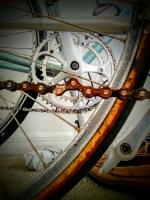
Stumbled upon some images I took of my former colleague's funky bicycle last year.
It's a unique bike with a
shaft drive and partially bamboo frame.
I don't know much about it's origins, but the colleague sent me this URL for reference:
https://www.rosslovegrove.com/commercial/biomega-bamboo
Doesn't look exactly like this unique and rare Biomega model. This particular bike seems to come from Denmark too and has a stylised V in the badge.

More images


Merida Scultura 5000 (2015)
Merida Big Nine 400 (2019)
We need to get our pedal power from the cranks to the rear wheel somehow.
Chains are clearly the most common way to propel us forward, and if you’re a regular reader here, you’ll have seen that I think belts are perfect for long-distance bike travellers.
There are far quirkier ways to propel a bike too, including shaft drive, hydraulic drive and even string drive!
I've been following the progress for a few years. I don't think I will ever fully commit to this. Interesting though for bikes.
What is a Shaft Drive Bicycle?
Drive shafts are commonly used in automotive and industrial applications. But what you may not know is that they’ve been used on bicycles for over 125 years.
Instead of using a chain and sprocket set up to rotate the rear wheel, two sets of bevel gears transfer energy to the rear wheel via a drive shaft. The entire drive system is usually housed in an aluminium case that doubles as the right-hand side chainstay of your frame.
Shaft drive bicycle manufacturers – who still exist today – promise no exposed moving parts, no greasy or broken chains, and no skipping gears, which all sound pretty good to me.
So, why have these drivetrains never taken off?
Derailleur Drivetrains Are Exceptional
Until they fail.
Derailleurs are undoubtedly the best drivetrain for the majority of cycling applications.
They are cheap to manufacture, lightweight, highly efficient, and with over a century of innovation – they work really well too. Derailleurs can also be fitted to almost all bikes, you can easily source replacement parts, and you can find someone who can adjust them in most towns.
As a shaft cannot be paired with derailleurs, this is a major reason why shaft drive bikes are not more widespread.
But if you prize the ability to go huge distances on your bike with almost no maintenance, or the ability to ride in horrific weather conditions without gear adjustment, gear skipping or the need to clear debris from your drivetrain – this is where gearbox systems shine, and shaft drive can be paired with an internal gear hub.
So, for the rest of the comparison, we will be assuming someone already wants a low maintenance gearbox bike but is deciding between using chains, belts and shafts.
Reduced Drive Efficiency
A shaft drivetrain has a lower efficiency than a chain or belt. The biggest energy losses are simply due to the change in rotation direction – once at the crankset and once again at the rear hub.
We don’t have a lot of efficiency data available here, but in 1983 Josef Keller compared an unspecified shaft drive with a singlespeed chain, and found a 7% difference in drive efficiency in the shaft. This was between 50 and 200 watts pedalling output (Radmarkt 12/1983, “Der Wirkungsgrad im Fahrradantrieb”, page 71-75).
Friction Facts have tested a singlespeed chain to be about 99% efficient at 150-watts (2-watts drag), and a belt drivetrain to be 98.6% efficient (2.45-watts drag) at 250 watts power output. Using this current data, it would mean a shaft drive is around 92% efficient (12-watts drag). That said, chains and lubricants in the early-1980s were not as good as they are today, so shafts are more likely to be less than 90% efficient.
I know these numbers don’t sound like a lot, but let’s say a 70kg rider with a 15kg shaft drive bike was riding up a hill with a 5% gradient. After 10km of riding (or approximately an hour) the shaft drive bike would be four minutes behind the chain drive bike (150 watts power output).
So in ridiculously muddy conditions, a shaft could technically work out to be more efficient than a chain or belt (assuming you don’t use a chaincase). Or another way to look at it, a shaft in good conditions is as efficient as a chain in super muddy ones.
Extra Weight penalty of 1-2 kilograms compared to a chain or belt drive train, too.
Two Wheels
Stay Safe
Robert
"SPINMAN"
As previously stated; shaft drives are nothing new, nor are bamboo and wood framed bikes.
Has anyone actually seen in personal or ridden a shaft drive bike. I have, a Columbia from somwhere around 1900. A complete dog, slow and extremely heavy. Icwould assume with modern technology and lighterweight materials there has been a great improvement regarding performance.
Aside from whetherbthat bike hasca shaft or derailleir is utterly neyond the point due to feame flex which cannot be made any better than natural material it is based upon. Even a wooden frame can be beefed up (similar to a CF frame) where needed without using other materials; a bamboo frame is pretty much limited to the actual diameter of the plant used it fit a very narrow range of frame components that fit it. Not to mention the expected deterioration of the fibers due to continued flexing (this happens to all materials, just keep bending a paper clip a little and it will break eventually) sooner or later. The reason why CF frames (though getting better through improved matrix/resin technology, though more environmentally toxic in its production) have a much more limited lifetime than do steel frames. The fiber will ladt a long time, but what holds it together will not (even if never ridden (glue breaks down with age).
The real advantage (as with wood) is ride comfort; but that can be built into other frames as well. Using more forgiving components (rims, tires, posts, bars, etc.) can equal or exceed the use of even the harshest frames making them comfortable also within reason.
They are cool bikes, but built merely as an oddity than as something that will displace a "standard" framed bike. If they were a great bike you would see a lot more of them. Even with a normal drive they are quite expensive. Why? Bamboo is cheap and easy to work with; but that bike does not reflect that fact (aside from all modern quality bikes being ridiculously overpriced).
Location: Silver City, NM, USA
Shaft drive motorcycles were a thing for a while, but I don't think they ever really caught on with the public, not in a way which would ever displace chain drive... some of those shaft drive cycles looked cool too, but I think they were also more expensive?

"Nothing ventured, nothing gained..."





![[-]](https://forums.bikeride.com/images/flatty/collapse.png "[-]")